| ||||||||||||||||||||||||||||||||||||
| ||||||||||||||||||||||||||||||||||||
Description While driving the early warning system monitors the functions of the transmission by means of measured quantities such as
. Under certain conditions such as
the early warning system detects a malfunction of the transmission functions. The early detection of such malfunctions of the transmission functions enables the transmission control unit to take appropriate action to prevent the transmission from taking further damage:
Shifting sequence and adaption During a shifting operation one multi-disk clutch is opened and another multi-disk clutch is closed. Opening and closing of the multi-disk clutches is accomplished by the timely coordinated adjustment of the corresponding oil pressure:
When closing the multi-disk clutch, the control pressure causes the disks to be pressed against each other with increasing force. The disks are "slipping" until the synchronous speed has been reached. In order to yield a good shifting quality, the total shifting time - but particularly the time during which the disks are slipping (slip time) - should lie within a certain range. When the shifting time leaves the specified range, the control pressure for the next shift is increased or reduced accordingly. This is called adaption.
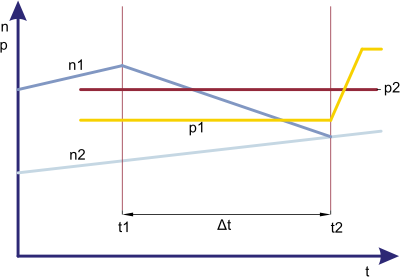
Monitoring the control pressure If the control pressure (p1) calculated by way of the adaption reaches an upper threshold (p2) of approximately 90% of the operating pressure, the early warning system reports a fault.
Monitoring the control pressure for the 2-3 shift: n1 – engine speed, n2 – output speed, Δt – slip time of the disks
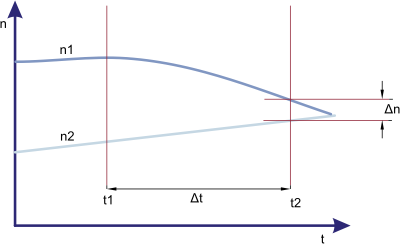
Monitoring the shift time By reducing or increasing the control pressure the adaption ensures that the shift time remains always within the specified range. Under certain circumstances the control pressure, although increased to the maximum value, is not able to complete the shifting operation within the specified maximum shift time (Δt). This means that after the maximum shift time (t2) has ended, the synchronous speed has not yet been reached and the disks are still slipping. The early warning system recognizes this condition and calculates the deviation (Δn) of the present speed values from the target speed values that should be achieved when the multi-disk clutch has been fully synchronized. If the deviation of the speed values exceeds a certain value, the early warning system reports a fault.
Monitoring the shift time for the 2-3 shift: n1 – engine speed, n2 – output speed, Δt – shift time
Slip monitoring After a shifting operation in a mechanical gear has been completed, the transmission input and output shafts normally rotate with a certain speed ratio. The early warning system continuously monitors this speed ratio. If the speed ration measured by the speed sensors deviates from the calculated target speed ratio, the early warning system detects slip in this gear. The slip monitoring is based on the comparison of n2 and n3 also for retarder braking. If slip of a certain magnitude (e.g. 100 1/min) is detected for a certain period of time (e.g. 1 second), the early warning system reports a fault. | ||||||||||||||||||||||||||||||||||||
 © by Voith Turbo GmbH & Co. KG send remarks to markus.zwickel@voith.com (documentation department) | ||||||||||||||||||||||||||||||||||||