Time stamps in event memory entries
 |
The information of "when" an event has occurred is one of the most important ambient conditions that are stored in the event memory. The answer to the question "“When?" helps us to put an event in a time context. In the transmission control unit, this question is answered by storing time stamps. Here, the term “time stamp” has to be taken almost literally. Similar to time clocks which document an event (such as arrival or departure) by means of a stamp on a time recording card, the control system documents events by means of a "stamp" (storing a time value) in the event memory. |
 |
With ALADIN 3.0 and higher, time stamps are represented not only traditionally in the event memory but also as diagrams. For further information, please see: Report Timing. |
 |
What are absolute and relative time indications? |
In order to be able to answer the question "When?", it has to be clear that we have to distinguish between absolute (point in time) and relative time indications (time span). Absolute time indications such as date and time require that these time indications are available in the vehicle and on the CAN bus. If this is the case, an absolute time stamp can be assigned to any event in the control system. Absolute time indications describe a point in time, e.g., it is 15:00. Relative time indications describe the time as a difference between two events, e.g. between switching on the ignition and the occurrence of an event or between reading the event memory and the occurrence of a previous event. Absolute time indications describe a time span, e.g., it takes 15 minutes.
|
|
How many time stamps exist? |
Some events can occur or disappear arbitrarily often. Thus, an incalculable number of time stamps would be generated (e.g. in case of loose contact). Because the memory space in the transmission control unit is limited, it is necessary to define which time stamps shall be stored. For the transmission control unit, these time stamps are the "first occurrence" and the "last disappearance" of an event. In case of loose contact, the time stamp for the last disappearance would change permanently, because there is a continuous change between "Error" (active)" and "No error" (inactive). The event memory of the transmission control unit may contain up to 10 different events. Each event has its own time stamp. Thus, the time flow of an event is analyzed separately for each event.
|
|
What does frequency mean? |
The frequency indicates how often an event has occurred between the thresholds "First occurrence" (becomes active for the first time) and "Last disappearance" (has become passive for the last time). The frequency counter counts up to the value 250. If an event occurs more often than 250 times, the counter value for the frequency is frozen at the value 251.
|
|
Representation in the report: |
The time values are represented in the format hh:mm:ss (hours:minutes:seconds). Thus, the value range for absolute times (points in time) ranges up to the maximum 23:59:59. Relative times (time spans) are not limited in upward direction, i.e. even values such as e.g. 1689:00:00 might occur.
The icons:
Period between ... system start and first occurrence of the event ...system start and last disappearance of the event ...last occurrence of the event and reading the event memory ...first disappearance of the event and reading the event memory Presentation in the report
Time stamp at "first occurrence"
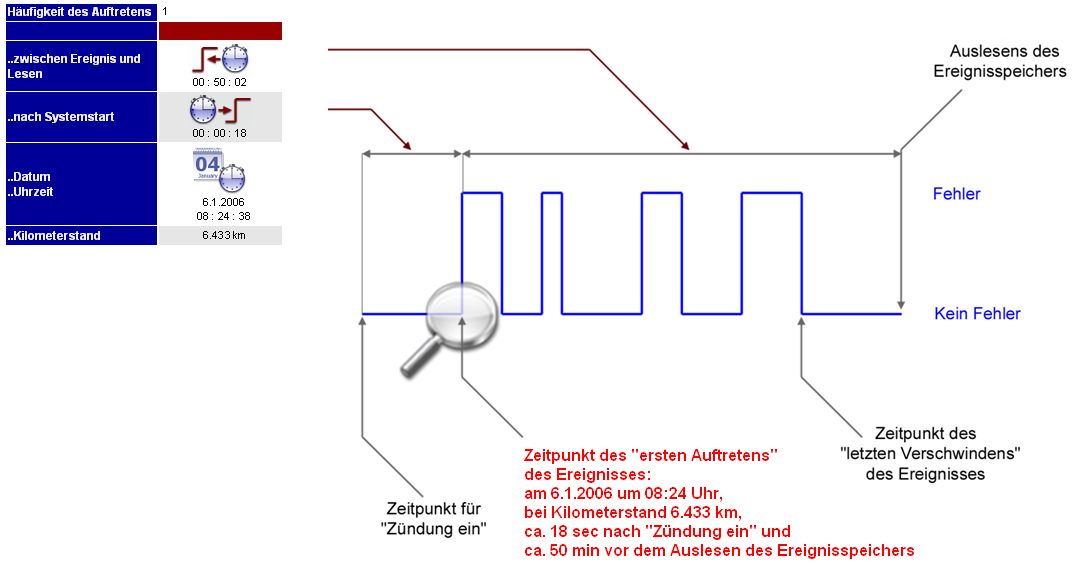
The transmission control unit sets the first time stamp at the first occurrence of an event. Date, time and mileage are entered, provided that these values exist on the CAN bus. Since these absolute values depend on the CAN bus, the fields may remain empty.
The time between booting up the control unit with "Ignition on" and the occurrence of the event is always entered. This time gives information on whether the fault already existed in the initialization phase of the transmission control unit or whether it occurred only in driving mode. The second relative time flag calculated when reading the event memory (performing an upload) is the time elapsed between the first occurrence of an event and reading the event memory.
Time stamp at "last disappearance"
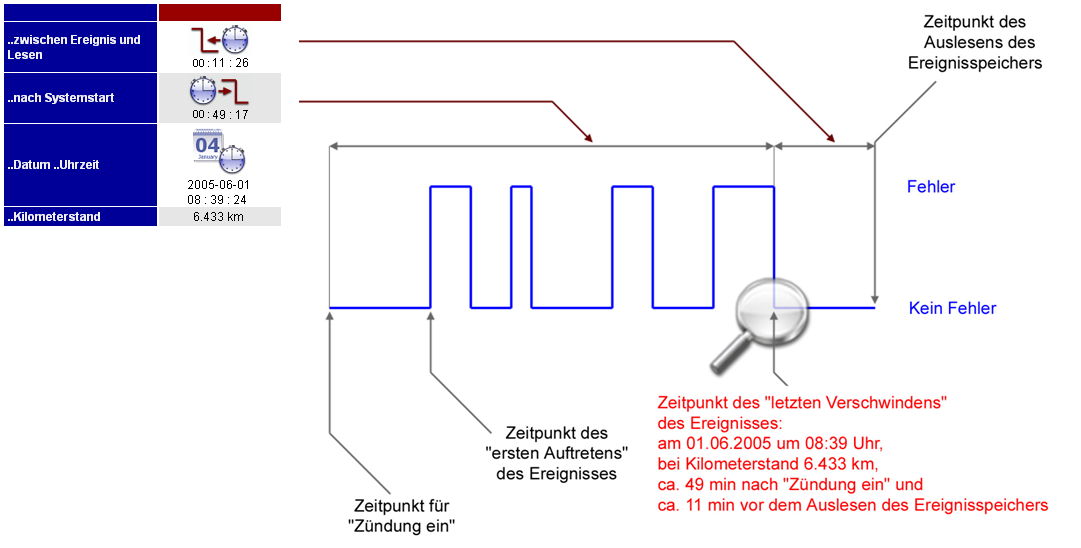
The second time stamp is set by the transmission control unit at the last disappearance of an event. Date, time and mileage are entered, provided that these values exist on the CAN bus. Since these absolute values depend on the CAN bus, the fields may remain empty.
The time between booting up the control system with "Ignition on" and the disappearance of the event is always entered. This time gives information on whether the fault already existed in the initialization phase of the transmission control unit or whether it disappeared only in driving mode. The second relative time flag calculated when reading the event memory (performing an upload) is the time elapsed between the last disappearance of an event and reading the event memory.
Example:
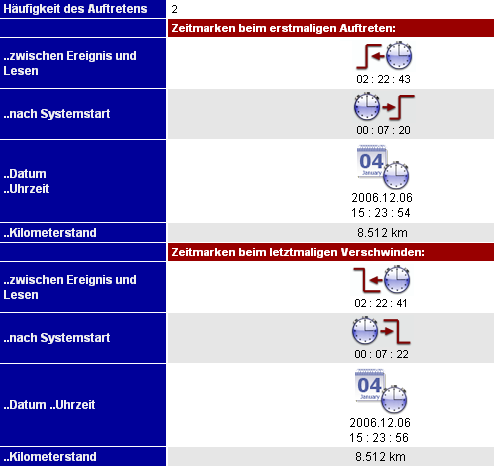
The section of the ECU report shown on the left contains the following information:
The event occurred two times on December 6th, 2006 between 15:23:54 and 15:23:56.
The first occurrence took place at 15:23:54, i.e. 7 minutes and 20 seconds after the ignition was switched on. This means, the engine was started at 15:16:34.
The same information can be calculated from the last disappearance. This event took place at 15:23:56, i.e. 7 minutes and 22 seconds after the ignition was switched on.
The total duration of the fault is 2 seconds. This value can be calculated from:
the absolute time stamps (15:23:56 - 15:23:54) or
the relative time stamps (00:07:22 - 00:07:20).
During these 2 seconds, the vehicle covered a distance of 0 kilometers (8,512 km – 8,512 km).


|
|
Further topics: |
More information on: Upload
More information on: Setup
More information on: Priorities
More information on: Active / passive events
More information on: Fault locations and fault types
More information on: Operational principle and clearing the event memory
More information on: FAQ
© by Voith Turbo GmbH & Co. KG
send remarks to joachim.ehleiter@voith.com (electronic department)
or r.theilacker@voith.com (electronic department)