Operational principle and clearing the event memory
 |
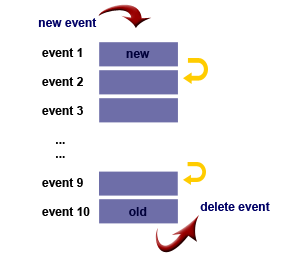
The event memory of a transmission control unit can store up to 10 autonomous events. This memory is designed as a FIFO memory (First In First Out). That means that the event memory has ten defined memory spaces. If a new event is to be entered, this will be done in the memory space on top. All other events move one space down. If the event memory is full, the oldest entry will be deleted automatically. You can also change this behavior in the dataset.
|
 |
Automatic delete operations in the event memory: |
- Automatic deletion when event memory is full
If an event is to be entered when the event memory is full, another event must be deleted from the memory instead. According to the FIFO principle, this should be the oldest entry. This function can be changed in the dataset.
Dataset value Description A When the event memory is full and a new event occurs, the oldest entry will be deleted. This is the default setting / FIFO principle. B When the event memory is full and a new event occurs, the event with the lowest priority (highest number) will be deleted. For further information, please see: Priorities.
- Automatic deletion of events that are not active
Event memory entries that are not active will be deleted automatically after a time to be set in the dataset, if the event is not active and did not reoccur within this period of time. This period of time is between 1 hour and 65,535 hours. The standard value is 200 hours. For further information, please see: Active / passive events.
- Automatic deletion when loading software and/or a dataset
The event memory is completely reorganized when software and/or the dataset is loaded. The event memory is completely cleared.
|
|
How to clear the event memory: |
You can delete the event memory using the "Clear Fault Memory" function. Click Service > Clear fault memory in the main menu.
Alternatively, you can delete the entries in the event memory either separately or all together in the Online monitor window. For further information, please see: Online monitor.
|
|
FAQ: |
Once I have deleted a fault, why is it not entered again immediately?
Within the transmission control unit, every fault signals both when it occurs (becomes active) and when it disappears (becomes passive). If the event memory is cleared after a fault has been entered, the fault must signal its disappearance first before it can be entered again. A new entry can thus only be made in the next operating cycle (ignition ON / OFF) or if the fault status changes from active to passive and to active again.
|
|
Further topics: |
More information on: Clear fault memory
More information on: Dataset
More information on: Upload
More information on: Setup
More information on: Priorities
More information on: Active / passive events
More information on: Fault locations and fault types
More information on: FAQ
© by Voith Turbo GmbH & Co. KG
send remarks to joachim.ehleiter@voith.com (electronic department)
or r.theilacker@voith.com (electronic department)